Dennis Bradley Mastery Journal
Full Sail University
Game Design
About
Date: May 17, 2026
Dennis C. Bradley Jr. is a game developer, U.S. Army veteran, and founder of Orange Sparrow Games. He recently completed his Bachelor of Science in Game Development at Full Sail University and is now pursuing a Master of Game Design at the same institution. Before entering game development, he served eight years in the U.S. Army as a Construction Equipment Repairer (91L), reaching the rank of Staff Sergeant, an experience that shaped his approach to problem solving, teamwork, and disciplined iteration. His path into game design began with a lifelong interest in play, mechanical systems, and world building, and he found the same satisfaction in taking apart a gameplay system that he once found in taking apart a small engine. He chose game design as a career because it rewards the layered systems thinking that has always come naturally to him, and today he works primarily in Unreal Engine 5 with C++, focusing on multiplayer systems, procedural environments, and player driven design while continuing to grow Orange Sparrow Games.

Intention
Over the next twelve months, I intend to use the Master of Game Design program as a structured environment to deepen my craft as a designer and to mature as a creative leader. My bachelor's degree gave me a strong technical foundation in Unreal Engine 5, C++, and multiplayer systems, but I recognize that strong engineering alone does not produce memorable games. The masters program is my opportunity to study design as its own discipline, to examine why certain mechanics resonate with players, and to sharpen the language I use to communicate design intent across teams. I intend to enter every course with the assumption that there is more to learn, and to treat each assignment as a chance to test ideas I can later apply inside Orange Sparrow Games.
A central goal for this year is to develop a complete design portfolio that demonstrates range. I want to move beyond systems I already know well, such as survival loops and procedural generation, and explore narrative design, level design, economy balancing, and player psychology in greater depth. I plan to use my ongoing work at Orange Sparrow Games as a living laboratory where coursework theory meets production reality. Each milestone I reach in school should also produce something tangible, whether a design document, a prototype, or a published devlog that strengthens my studio's professional presence.
Beyond the technical and creative goals, I intend to grow as a collaborator and mentor. I have spent years leading soldiers and small development teams, and I want to refine the way I give feedback, run playtests, and support teammates through difficult creative decisions. By the end of this program I hope to graduate not only with a stronger design portfolio but with a clearer professional identity as a designer who builds thoughtful, durable games and who lifts the people around me while doing the work.
Inspiration
Date: May 17, 2026
"It happens." (Zemeckis, 1994)
This line comes from one of my favorite moments in Forrest Gump, when Forrest is running across the country and a man chasing him slips in dog mess. Forrest does not stop, does not give a long explanation, he just shrugs it off with "It happens" and keeps going (Zemeckis, 1994). That mindset has stayed with me for years because it captures exactly how I try to approach life. What inspires me to work as hard as I do is my family. There is no other reason I push through long nights of coursework, hours of debugging code, and the pursuit of a masters degree while running my own studio. I understood at a young age that the future I want for my children and for the generations that follow will require sacrifices made now. Life is going to throw setbacks, mistakes, and plain bad luck at me along the way, and the only thing that matters is whether I keep moving forward. "It happens" is my reminder to absorb the mess, take the next step, and stay focused on being a step ladder for the people who come after me.
References
Zemeckis, R. (Director). (1994). Forrest Gump [Film]. Paramount Pictures.
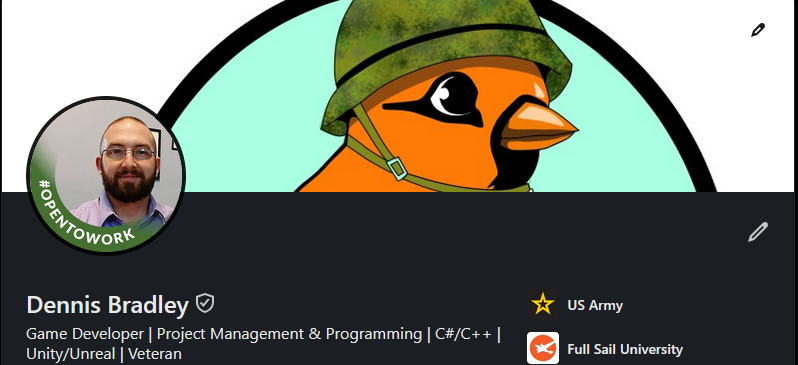
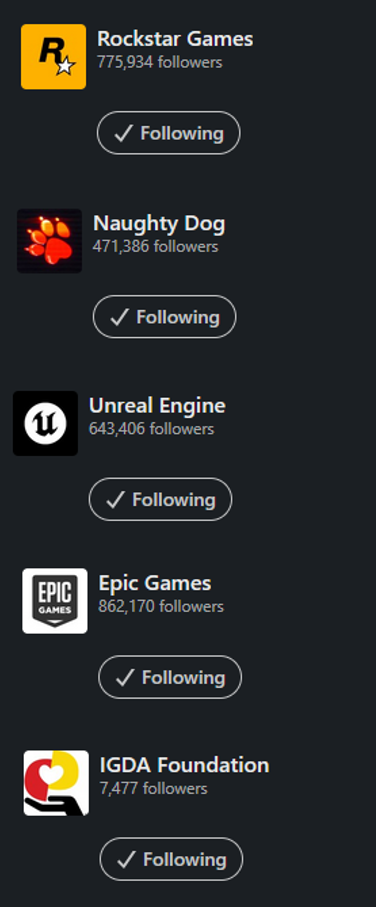
Most of the companies I follow come straight from game development, the studios and engine makers tied to the work I do every day. I also follow large tech companies on purpose. The big names lead the way on innovation, and what they build often becomes the standard everyone else works from. In a field that moves this fast, keeping up with the leaders is how I stay sharp.
Who I follow
Inspiration
Date: May 24, 2026
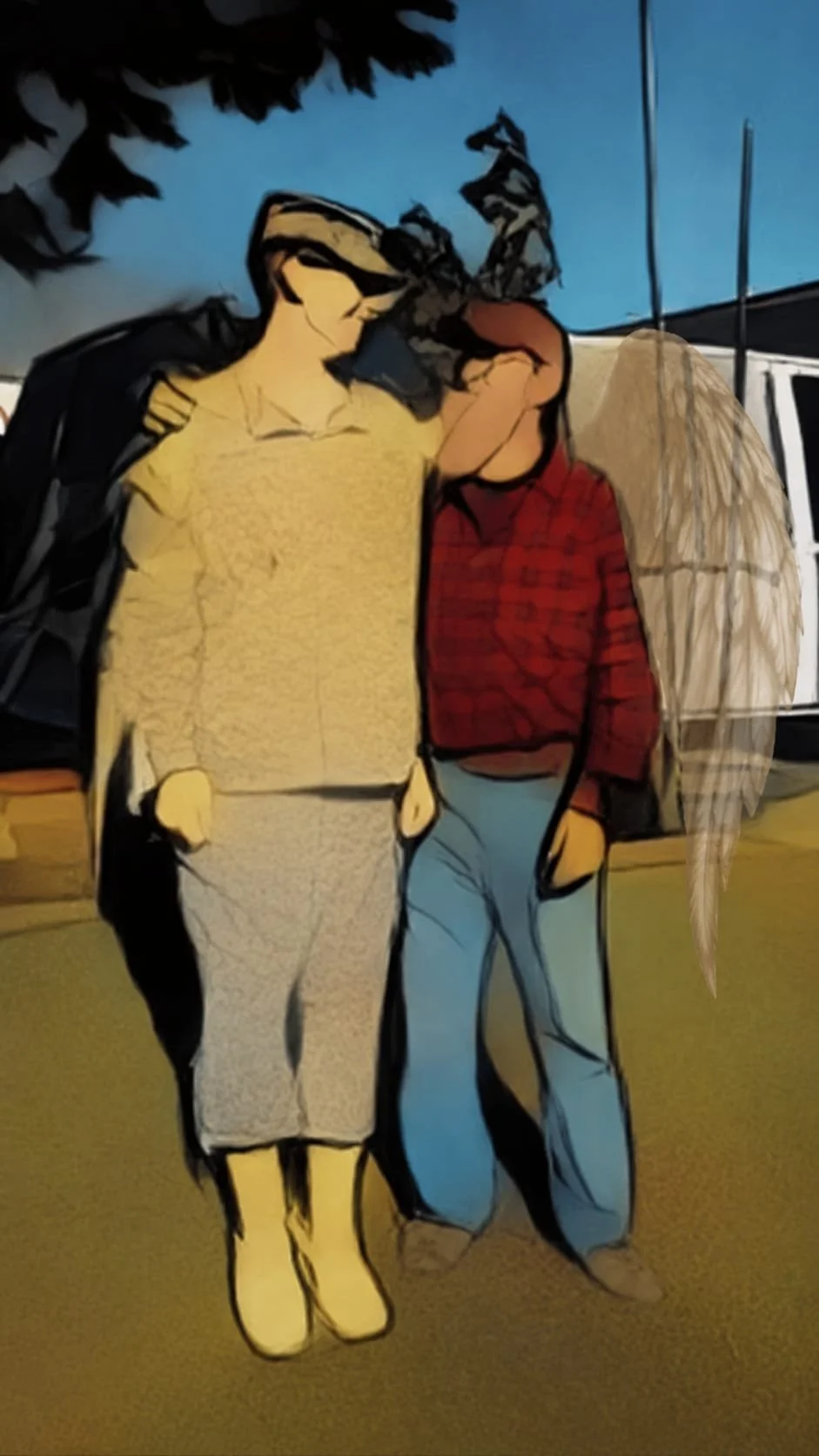
‘It's talk to you later, never goodbye.'
-Papa
That's how my Papa ended every phone call. To me it always meant there is more ahead, and nothing worth having truly ends.
It stuck with me again while studying Robert Greene this term, since he talks about purpose and growth as something you keep moving through rather than finish. I chose this because it carries the man who helped raise me, and a mindset I try to hold onto in my own work.
Date: May 31st, 2026
The Mastery Journey: A Developer's Roadmap.
Overarching career goal (long term)
Become a senior gameplay and tools engineer in the game industry while growing Orange Sparrow Games into a sustainable independent studio.
Graduation goal (short term)
Within one month of completing my Master of Game Design, release a public playable build of my current game project and submit applications to at least fifteen gameplay or tools engineering positions.
Timeline
Finish the current vertical slice. Lock the core gameplay and multiplayer systems into a stable, demo ready build.
Rebuild the portfolio. Update orangesparrowgames.com with a technical breakdown and devlogs that double as engineering proof of work.
Deepen the engineering skill set. Sharpen the gameplay and tools programming side through focused practice and technical projects, so the engineering track stands on proof of work.
Build the network. Join the IGDA, plug into a chapter or special interest group, and put work in front of people through the student portfolio showcase.
Ship the demo. Release the public build on steam and stand up a store page to validate the studio track.
Apply and pitch. Submit applications to gameplay and tools engineering roles while pitching the studio's next project for contract or funding.
Set the next milestone. Use feedback from the demo and from interviews to scope the studio's follow up project and a twelve month roadmap.
Network and Community
A roadmap only holds up if it is tied to people who are already doing the work. Three communities anchor mine.
The first is my industry association. Joining the International Game Developers Association is my first concrete move toward an industry network. As a student member I can use the career center for early job postings and coaching, enter the student portfolio showcase to put my work in front of employers, and join the global mentorship program to get direct feedback on both the engineering and the studio sides of my plan (International Game Developers Association, n.d.).
The second is my Professional Learning Network. It runs through my public devlogs, my itch.io & steam presence, the teammates I work with at Underscore Games, and the connections I am building through coursework. All of it keeps me in regular contact with working developers instead of learning in isolation.
The third is the Full Sail community. I can lean on the student project community and the alumni network, which has a strong footprint across the game industry, to find collaborators, referrals, and people who have already made the jump from capstone to shipped product.
I am working through this plan with design thinking rather than a fixed checklist. Mootee (2013) describes design thinking as a way to work well with others, communicate, empathize, anticipate, and exchange. The build, the portfolio, and even the job search all improve through the same prototype and iterate loop instead of a single attempt, so every step above is a draft I expect to revise.
References
International Game Developers Association. (n.d.). Membership. IGDA. https://igda.org/membership/
Mootee, I. (2013). Design thinking for strategic innovation: What they can't teach you at business or design school. Wiley. Accessed through the Full Sail Library via O'Reilly.